2026 Oscars: The best movies based on books you should watch and read

Por Maribel Lienhard

There are faithful adaptations as well as looser versions. Among them are ‘One Battle After Battle’, ‘Hamnet’, ‘Frankenstein’, ‘Train Dreams’, and ‘Marty Supreme’. They demonstrate how literature remains an inexhaustible source for cinema. Discover the plots, the characters, and the interesting facts that link each story to its original work

The origin and causes of wars: why humanity remains in conflict

Por Winston Manrique Sabogal

Following the joint US-Israeli attack on Iran and the death of Ayatollah Ali Khamenei, which adds to the conflicts in Ukraine and Gaza, war is once again straining the world. Two books by Richard Overy and Alfredo González Ruibal trace, from prehistory to the present day, why war has been a constant: Is it the instinct for survival? Biology? A human anomaly? Or is it the triad of power, selfishness, and narcissism?

2026, the year of the dystopia of ‘Metropolis’ and its similarities with the present, according to writers, philosophers and scientists (and 2)

Por Winston Manrique Sabogal

Thea von Harbou's 1925 novel, on which Fritz Lang's iconic 1927 film is based, is set in 2026, depicting the excesses of a world divided between the powerful and technologically advanced and the enslaved workers. WMagazín invited several authors to reflect on what aspects of this prophecy have come to pass and how it has transformed other areas that have humanity trapped in a cycle of political and social upheaval

2026, the year of the dystopia of ‘Metropolis’ and its similarities to the present, according to writers, philosophers, and scientists (1)

Por Winston Manrique Sabogal

Thea von Harbou’s novel (1925), on which Fritz Lang’s iconic film (1927) is based, takes place in this year. The story of a megacity where the powerful and technocrats live on the surface and enslaved workers live underground, until one day a robot… WMagazín invited several authors to reflect on the extent to which this prophecy has come true and how it has transformed other areas that have humanity trapped, from politics to society

Shakespeare’s ‘Hamlet’ and O’Farrell’s ‘Hamnet’ (and 2): origin and evolution of the story of the Prince of Denmark leading up to Chloé Zhao’s film

Por Winston Manrique Sabogal

This is a story about how originality is a hybrid, drawing from many sources. We recall the genealogy of this classic, whose primary source is a medieval legend, revived by the film adaptation of the novel that fictionalizes Shakespeare's inspiration for ‘Hamlet’ from the death of his only son, Hamnet. It all begins with the myth of Orpheus and Eurydice

Benjamin Lacombe: “We forget that the origin of humanity’s success is generosity and mutual support”

Por Winston Manrique Sabogal

The renowned French illustrator of children's and young adult literature, as well as adult classics, celebrates a quarter of a century with three collector's editions: 'The Great Gatsby' (Fitzgerald), 'The Little Match Girl' (Andersen), and 'Father Christmas's Childhood,' an original book with text by Sébastien Perez. In this interview, he reveals his creative process, his working methods, and how he reinterprets his work

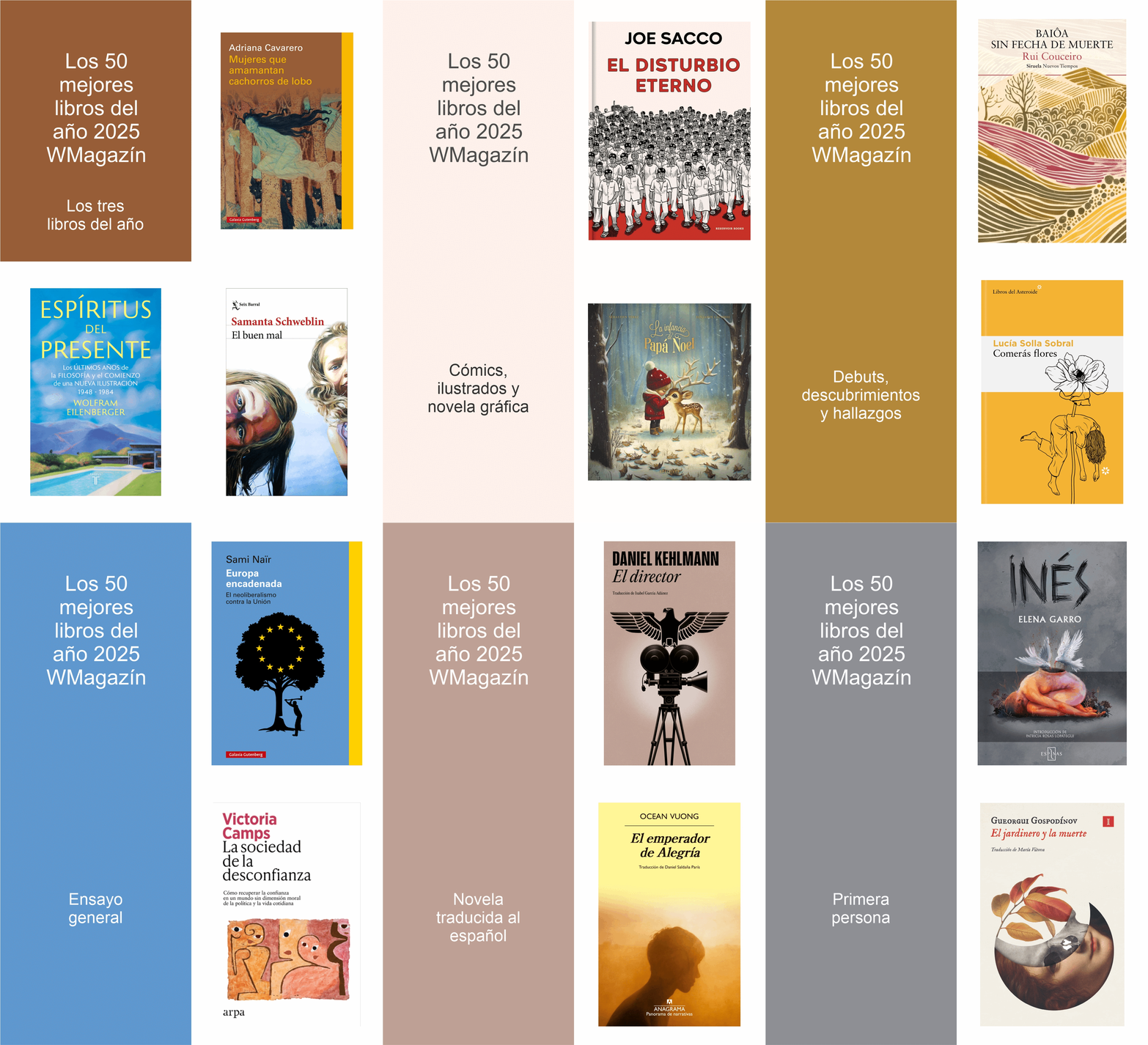
WMagazin’s Top 50 Books of 2025, Listed by Literary Genre

Por Winston Manrique Sabogal

‘Women Who Breastfeed Wolf Cubs’; by Adriana Cavarero; ‘Spirits of the Present’; by Wolfram Eilenberger; and ‘Good and Evil’; by Samanta Schweblin are the three best works. This selection of the 50 best features established authors such as Sami Naïr, Javier Cercas, Cristina Fernández Cubas, Fleur Jaeggy, Daniel Kehlmann, Juan Gabriel Vásquez, Victoria Camps, and González Iglesias alongside emerging voices like Dahlia de la Cerda, Ocean Vuong, Rui Couceiro, and Lucía Solla Sobral. It also includes valuable rediscoveries such as those of Chaves Nogales and Elena Garro

This is how life, beauty, love, sex, and happiness have changed in the 21st century, according to 250 writers, artists, philosophers, sociologists, and scientists

Por WMagazín

Winston Manrique Sabogal’s book, ‘The Great Transformation’, reveals the metamorphosis these four fundamental human desires have undergone, driven by the digital age. It presents a new perspective with insights from prominent figures such as Gabriel García Márquez, Toni Morrison, Martin Baron, Annie Ernaux, Frank Wilczek, Chuck Palahniuk, Olga Tokarczuk, Samanta Schweblin, Margaret Atwood, Umberto Eco, Javier Marías, André Aciman and Gilles Lipovetsky

Artificial intelligence in the world of books and literature (3): Cultural revolution and paradigm shift

Por Winston Manrique Sabogal

Third installment in this series featuring a dozen writers, philosophers, experts, and sociologists from different countries. Has the era of the written word ended and the era of the oral tradition begun? The habits of society and readers are changing at breakneck speed. Myths, doubts, fears, questions, advantages, and disadvantages of this new age

Artificial intelligence in the world of books and literature (1): Authorship and the new role of the human being in creation

Por Winston Manrique Sabogal

From Nobel Laureate in Literature Abdulrazak Gurnah to ten writers, editors, historians, sociologists, philosophers from different countries, and the writing machine itself, WMagazín reflects on the real capacity and presence of this technology in writing. An innovation that leads to a reconsideration of the very meaning of art in the posthuman era